I'm too verbose for twitter...
7925 stories
·
31 followers

Data Centers Use Less Water Than Almond Farms—and Do More Good

1 Comment
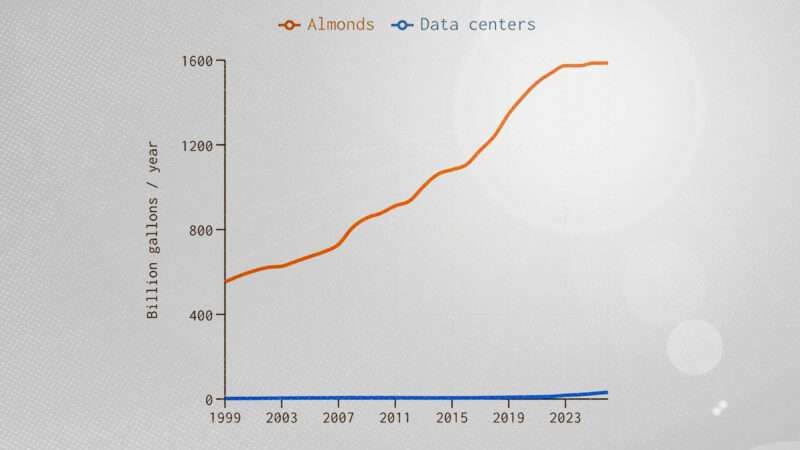
A line graph showing almonds consume far more water than data centers | JoshEakle/substack

Opposition to data centers is all the rage among populists of all stripes. On the left, Sen. Bernie Sanders (I–Vt.) has proposed a national moratorium on new data center construction; on the right, Tucker Carlson describes them as "dystopian" and "devouring American energy and jobs." In recent days, X has become flooded with images of pristine American forests, plains, beaches, and lakes alongside captions warning that no data center is worth losing this. (The images are often AI-generated, and many of the accounts sharing them are foreign.)

Data center panic is fueled by concerns about electricity and water usage. Many Americans wrongly believe that data centers are driving up their electric bill, even though evidence suggests the exact opposite: Data centers may actually decrease electricity costs for their neighbors. Water use fears are even more unreasonable. Data centers don't actually use all that much water.

For example, a chart comparing data centers' water requirements to almond farms helps put things in perspective.

California's almond farms consume 4.2 billion gallons of waters per day, according to Reason's Christian Britschgi. Data centers consume just 46 million gallons per day. Those numbers will certainly rise over time, but compared to all the other things that use water—golf courses account for 1.4 billion gallons per day—it's just a drop in the bucket.

Unfortunately, many foes of data centers do not find this comparison very compelling. Speaking for the opposition, The Federalist's Sean Davis points out that almonds are, you know, food. People eat almonds. They can't eat data. Thus, almond farms are a good use of water and data centers are not.

Carlson made a similar argument during his debate with Kevin O'Leary, in which he took it as a knock against data centers that they wouldn't provide as many jobs as the city of Manhattan despite taking up more space and using about as much power.

It's a problem for data center advocates, I suppose, that the good being produced is not as obvious as a job or an almond. But you have to be pretty dense not to realize that the data centers make possible a huge amount of economically beneficial activity. Storing massive amounts of data is a necessary precondition for the modern economy. It will be used to power and train AI models that will improve everyone's lives. AI is already making medical diagnoses more accurate and reducing car crash fatalities via driverless vehicles. AI can swiftly navigate legal, regulatory, and licensing issues, making it easier to start a business or buy a home. As a research tool, it can cut down on time spent learning about a complicated issue.

Reducing the time it takes to complete an annoying (or dangerous) task is a huge benefit that allows people to spend their time—the ultimate finite resource—more effectively, if only for leisure. If this doesn't seem obviously beneficial, then consider where we would be without search engines at all. Not so long ago, people had to trek to the library and consult an encyclopedia when they wanted information. They had to obtain physical copies of relevant documents: books, newspapers, etc. Being able to summon these things instantly—electronically—has inarguably led to huge gains: There are countless jobs that simply would not exist without it (including internet commentator).

The United States' economic future is inexorably tied to the tech sector. Gains from AI are vital to the country's stability. In that sense, it's not very surprising to discover that some of the arguments against AI are being made in coordination with the Chinese government. According to the Bitcoin Policy Institute, the Chinese Communist Party has indirectly encouraged a pause or slowing of AI developments in the U.S.—but not in China. That's one reason Sen. John Fetterman (D–Pa.), a self-described "pro-capitalist Democrat," called Sanders' data center moratorium proposal "China first."

In any case, you can't eat an oil rig, a suspension bridge, or a satellite. Yet it should be obvious that these are no less useful—even factoring in land, energy, and water use—than almonds, even if the benefits are slightly less straightforward. This is plainly true for data centers as well, and anyone arguing otherwise deserves suspicious looks.

The post Data Centers Use Less Water Than Almond Farms—and Do More Good appeared first on Reason.com.

Read the whole story
kazriko
8 days ago
reply
Water is the dumbest reason to oppose Datacenters. A much more important reason would be electricity prices.
Colorado Plateau
fxer
8 days ago
The best reason is ridiculous fuckin tax breaks they get showered with at local/state/federal level for providing like, 80 jobs.
Share this story
Delete

Ep. 176 - Epilogue

1 Comment

Read the whole story
kazriko
20 days ago
reply
Another comic completed, 11 days left until it goes behind the paywall.
Colorado Plateau
Share this story
Delete

‘Noir, Japan’s Hard-Boiled Bittersweet Answer to Oreos’

2 Comments

Jake Adelstein (author of Tokyo Vice) on his blog Tokyo Paladin:

For decades, Japan’s Oreos weren’t made by Nabisco at all. They were produced domestically by Yamazaki Biscuits, under a licensing arrangement with what eventually became Mondelez International. This was, by most accounts, a reasonable arrangement. The cookies were local. The quality was consistent. Nobody was complaining.

Then Mondelez did what corporations do when things are working fine. The license expired, and Mondelez moved production of the Oreos it sells in Japan to China, exporting them to Japanese wholesalers and retailers. A cost decision. A spreadsheet decision. The kind of decision made in a room with no windows and a very good projector.

Sensitive Japanese consumers noticed quickly — the taste had changed. Into that opening stepped the Noir, inheriting the flavor the old Oreo had left behind.

Yamazaki Biscuits launched Noir in December 2017 as the successor nobody had officially asked for and everybody apparently wanted.

I have a great affinity for Newman-O’s, which I’ve previously described as “the cookies Oreos pretend to be”. Turns out though I’ve mostly sung the praises of Newman-O’s on my podcast and social media, not here on Daring Fireball. I love Newman-O’s, never tire of them, and will fight any man who argues that Oreos taste better. In fact, late last night, when a friend texted me with a link to this story from Adelstein, I was by sheer happenstance eating a few Newman-O’s. True story.

But now I’m fascinated by the existence of these Japanese rivals. A spite Oreo called Noir. They look and sound delicious, but they seem difficult to obtain in the U.S.

Link: tokyopaladin.substack.com/p/the-japanese-oreo-noir-kills…

Read the whole story
kazriko
22 days ago
reply
Noireos
Colorado Plateau
satadru
22 days ago
reply
“Spite Oreos” is a great phrase.
New York, NY
Share this story
Delete

The text mode lie: why modern TUIs are a nightmare for accessibility

1 Comment and 2 Shares

There is a persistent misconception among sighted developers: if an application runs in a terminal, it is inherently accessible. The logic assumes that because there are no graphics, no complex DOM, and no WebGL canvases, the content is just raw ASCII text that a screen reader can easily parse.

The reality is different. Most modern Text User Interfaces (TUIs) are often more hostile to accessibility than poorly coded graphical interfaces. The very tools designed to improve the Developer Experience (DX) in the terminal—frameworks like Ink (JS/React), Bubble Tea (Go), or tcell—are actively destroying the experience for blind users.

↫ Casey Reeves

The core reason should be obvious: the command-line interface, at its core, is just a stream of data with the newest data at the bottom, linearly going back in time as you go up. Any screen reader can deal with this fairly easily, and while I personally have no need for such a tool, I’ve heard from those that do that kernel-level screen readers are quite good at what they do. TUIs, or text-based user interfaces, made with modern frameworks are actually very different: they’re “2D grid[s] of pixels, where every character cell is a pixel. [They] abandons the temporal flow for a spatial layout.”

It should become immediately obvious that screen readers won’t really know what to do with this, and Reeves gives countless examples, but the short version is this: the cursor jumps all over the place with every screen update, which makes screen readers go nuts. Various older TUIs, made in a time well before these modern TUI frameworks came about, were designed in a much more terminal-friendly way, or give you options to hide the cursor to solve the problem that way. Irssi, for example, uses VT100 scrolling regions instead of redrawing the whole screen every time something changes.

I had never really stopped to think about TUIs and screen readers, as is common among us sighted people. The problems Reeves describes seem to stem not so much from TUIs being inherently inaccessible, but from modern frameworks not actually making use of the terminal’s core feature set. I really hope this Reeves’ article shines a light on this problem, and that the people developing these modern TUIs start taking accessibility more seriously.

Read the whole story
kazriko
22 days ago
reply
This is why they're tui's and not cli. cli is what they're looking for here for accessibility. Of course, the new TUIs are much more like DOS text user interfaces.
Colorado Plateau
satadru
23 days ago
reply
New York, NY
Share this story
Delete

Make It Myself

4 Comments and 12 Shares
It's not as big a loss as it looks, because now I have leftover supplies, which will help me talk myself into doing this all over again with a new project!
Read the whole story
kazriko
43 days ago
reply
I've definitely spent $300 on a project that was only in the end for decoration, like my Gameboy Advace CM3 unit, and my Cinna-Minty Pi v3. Of course, now I have the steamdeck and modded vita to take the place of those, but it was still fun to build them.
Colorado Plateau
christophersw
43 days ago
reply
Baltimore, MD
Share this story
Delete
3 public comments
deebee
39 days ago
reply
this cuts deep
America City, America
GaryBIshop
44 days ago
reply
My experience!
alt_text_bot
45 days ago
reply
It's not as big a loss as it looks, because now I have have leftover supplies, which will help me talk myself into doing this all over again with a new project!

FCC just handed Netgear a de facto router monopoly in the US

1 Comment

The Federal Communications Commission has announced that Netgear has been given conditional approval that effectively exempts it from a previous ban on foreign-made networking routers. The conditional approval gives the company a de facto — though potentially temporary — monopoly on the selling and servicing of new consumer routers in the US.

"We're pleased to share that Netgear is the first retail consumer router company to receive conditional approval from the Federal Communications Commission (FCC) as a trusted consumer router company," Netgear CEO CJ Prober said in a statement. "As a US founded and headquartered company, Netgear is aligned with the vision for a more secure digital future for our customers. For the last thirty years, we have been, and continue to be, committed to leading the consumer router category for the United States and setting the bar for quality, performance, innovation and security."

Both Netgear's lines of Nighthawk and Orbi mesh routers are covered by the approval until October 1, 2027, which appears to mean that the company can continue to offer software updates to both lines and presumably release and sell new models in the future.

The FCC dramatically expanded the Covered List, a collection of communications equipment seen as posing a risk to national security, to cover all foreign-made routers in March 2026. The decision prevents companies who make routers outside of the US from introducing new foreign-made models, and pushing certain software updates to existing models after March 1, 2027. Confusingly, though, it doesn't require anyone to replace their existing router or prevent those companies from selling routers they've already made. Receiving conditional approval is the definitive way companies can get off the list, but part of the FCC's requirements for approval is the company offering a plan to bring some or all of its manufacturing to the US — a theoretically costly decision.

Engadget has contacted Netgear for information about the US manufacturing plan it included in its application for conditional approval. We'll update this article if we hear back.

The vast majority of router companies, even ones that are headquartered in the US like Netgear, build their routers in Asia. It's not clear what makes Netgear's currently foreign-made routers safer than, say, an Amazon Eero 7 or a Google Nest WiFi Pro. Until other companies are given conditional approval, though, Netgear is in a unique position.

This article originally appeared on Engadget at https://www.engadget.com/cybersecurity/fcc-just-handed-netgear-a-de-facto-router-monopoly-in-the-us-223712324.html?src=rss

Read the whole story
kazriko
44 days ago
reply
The process of building a home-made router is pretty simple though. https://youtu.be/aiy5MIl03tY
This shows how low end the hardware can be, even though you need something of at least a Pentium 3 or 4 to reach gigabit routing speeds. A 133mhz pentium 1 can only do about 20-40 megabits.
Colorado Plateau
Share this story
Delete
Next Page of Stories